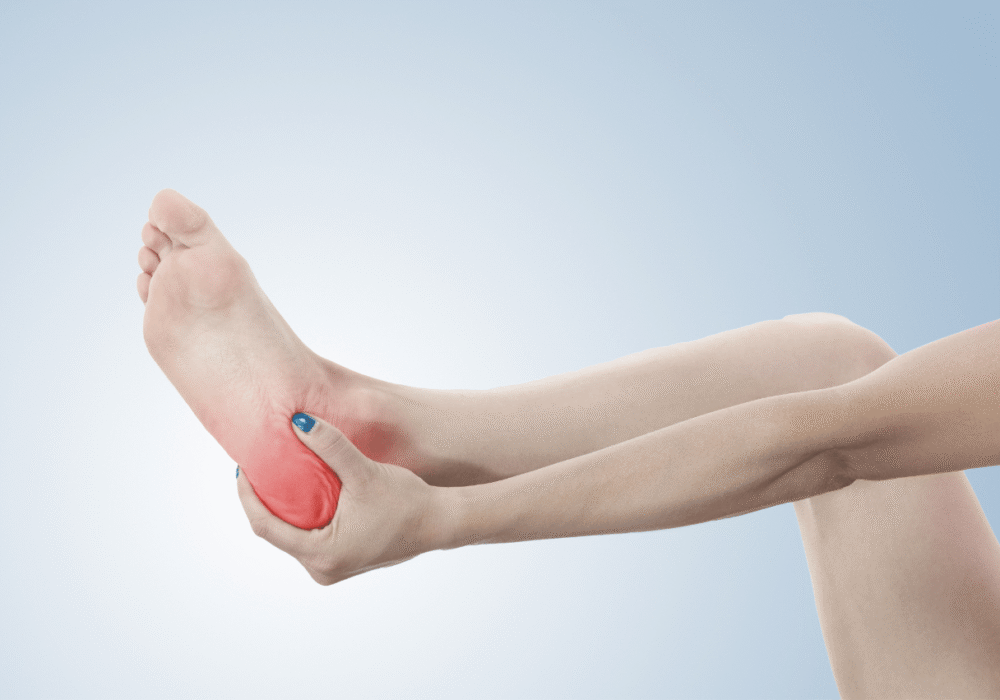
Roughly 1 in 10 people experience plantar fasciitis at some point in their lives. It’s the #1 reason people self-refer to our podiatry clinics in Geelong and Colac.
You might know plantar fasciitis as that sharp pain in your heel that peaks when you get out of bed or stand up after resting. The good news is: there are plenty of ways to get you from “hobbling around the kitchen every morning” back to moving freely again.
But which treatment is right for you? Let’s take a look at some ways to treat plantar fasciitis and how our podiatrists approach it at Prosper Health Group.
Quick summary:
- Plantar fasciitis involves overload or degeneration of the plantar fascia (the thick band of tissue running along the sole of your foot) and is a leading cause of heel pain.
- First-line treatment for plantar fasciitis includes targeted stretching, physiotherapy, and load management, with orthotics often playing a key supporting role.
- For stubborn or long-standing cases, clinical treatments like shockwave therapy, foot mobilisation, and prolotherapy can stimulate healing.
What is plantar fasciitis?
The plantar fascia is a thick band of connective tissue that runs along the bottom of your foot, from the heel bone to the base of your toes. Its job is to support the arch and absorb load with every step.

Plantar fasciitis refers to inflammation or overload at the point where the fascia attaches to the heel. It’s often most painful when standing after rest (particularly with your first steps in the morning) and can make it difficult to walk.
When pain persists beyond around two months, the condition often shifts into what clinicians call plantar fasciosis or fasciopathy: a degenerative state where the tissue starts to break down rather than simply staying inflamed. This is an important distinction, because the treatment changes depending on which stage you’re in.
What causes plantar fasciitis?
Plantar fasciitis is almost always a load problem. The tissue is being asked to absorb more stress than it can handle, and over time, it reacts.
Common contributing factors include:
- A sudden increase in activity. Starting a new walking routine, ramping up training, spending more time on hard surfaces, etc.
- Tight calf muscles and a restricted Achilles tendon, which transfer excess load to the plantar fascia
- Flat feet or high arches that alter how force travels through the foot
- Unsupportive footwear, particularly flat shoes or worn-out runners
- Spending long hours on your feet each day, especially on hard floors
- Excess body weight, which increases the load on the plantar fascia with each step
Age is also a factor; the plantar fascia loses elasticity over time, making it more susceptible to overload in people over 40.
Treatment for plantar fasciitis
Sometimes, treating plantar fasciitis isn’t a single fix. If regular stretching and strengthening your feet at home doesn’t get rid of the pain, you may need to consult a podiatrist.
Stretching at home
Stretching is one of the most effective and accessible things you can do, particularly in the early stages.
The two stretches we recommend are:
- Calf stretch against a wall
Back leg straight, front knee bent, held for 30 seconds on each side. This targets the gastrocnemius, the large calf muscle that has the greatest influence on plantar fascia tension.
- Plantar fascia stretch
Seated, foot crossed over your knee, toes gently pulled back toward your shin. Best done before your first steps of the morning, when the fascia is at its most vulnerable.
Other things to try at home include using a tennis ball to massage the arch of your foot, updating your footwear, and limiting high-impact activity that puts strain on your foot (try replacing running with swimming or cycling).
If you’ve tried these and are still experiencing heel pain, it’s time to see a podiatrist.
Physiotherapy
Physiotherapy uses a combination of manual therapy, progressive strengthening exercises, and movement retraining to reduce strain on the plantar fascia.
When plantar fasciitis is driven by weakness or movement problems further up the body, stretching alone likely won’t fix the problem. Physiotherapy addresses the full picture, including calf and hip strength, walking mechanics, pre-existing injuries, and load management through your recovery.
Foot mobilisation
Stiff joints in the foot and ankle can be a hidden driver of plantar fasciitis. When the joints aren’t moving freely, the plantar fascia absorbs more pressure.
Foot mobilisation and manipulation involve hands-on treatment from a podiatrist to restore normal joint movement in the foot and ankle. The sessions are gentle and non-invasive, and they’re particularly useful in the early stages of chronic heel pain where stiffness is inhibiting mobility.
Improved joint movement also means surrounding muscles can do their job more efficiently, which reduces the strain on the plantar fascia.
Orthotics
Foot orthotics are customised medical-grade shoe inserts designed to support and improve the function of your feet. Orthotics can redistribute load away from the plantar fascia by better supporting the arch and correcting the way force travels through your foot.
At Prosper Health Group, orthotics are designed based on a detailed biomechanical assessment and video gait analysis, with 3D scanning used to capture the exact contour of your foot. They’re then 3D-printed and finished in-house, allowing the fit to be fine-tuned until it’s right for your foot.
Shockwave therapy
For plantar fasciitis that hasn’t improved despite consistent stretching, footwear changes, and orthotics, shockwave therapy is a well-supported next step.
Shockwave therapy sends acoustic energy waves through the skin to the affected tissue. This triggers the body’s natural repair response. improving blood flow, stimulating cell regeneration, and helping break down calcification that can build up in chronic cases.
Clinical research reports a 72% reduction in pain scores from patients with chronic plantar fasciitis following shockwave therapy. It’s an effective treatment for heel pain and is available at both our Geelong and Colac clinics.
Learn more about how shockwave therapy works.
Prolotherapy
For chronic cases where the plantar fascia has degenerated and won’t heal on its own, prolotherapy offers a regenerative option.
Prolotherapy (short for “proliferative therapy”) involves a series of small injections of a dextrose (sugar-based) solution into the damaged tissue, which triggers a controlled healing response. The body responds by producing new collagen, restoring tissue structure, and strengthening the attachment at the heel.
It’s particularly effective for ligament laxity, tendon injuries, joint instability, and heel pain that persists despite conservative care.
Frequently asked questions about plantar fasciitis treatment
How long does plantar fasciitis take to heal?
It varies significantly depending on how long the condition has been present and how consistently treatment is followed. With certain treatment, including home stretching and strengthening, acute cases can resolve in six to eight weeks. Chronic cases can take six months or longer. Clinical treatment can speed this process up considerably.
What is the fastest way to treat plantar fasciitis?
The fastest results tend to come from combining stretching and load management with hands-on treatment from a podiatrist.
Is plantar fasciitis the same as a heel spur?
Not quite. A heel spur is a bony growth that can develop at the attachment point of the plantar fascia. Many people have plantar fasciitis without a visible spur on imaging. With plantar fasciitis, the pain comes from the plantar fascia, not a spur.
Should I rest completely from exercise with plantar fasciitis?
Complete rest is rarely necessary. A better approach is to modify activity. Replace high-impact exercise like running with swimming or cycling. Your podiatrist can help guide what’s appropriate based on the severity of your symptoms.
Can a podiatrist treat plantar fasciitis?
Yes. At Prosper Health Group in Highton (Geelong) and Colac, our podiatrists provide comprehensive plantar fasciitis assessment and treatment, including orthotics, shockwave therapy, foot mobilisation, and prolotherapy. Get in touch with us so we can assess your situation and have you walking pain-free again.
Take your first steps towards being pain-free
The longer plantar fasciitis is left, the more likely it is to shift from an inflammatory phase into a degenerative one, and the harder it becomes to resolve.
At Prosper Health Group in Highton and Colac, our podiatrists assess your situation and use a wide range of effective treatments customised around your lifestyle and goals.
Get rid of that heel pain for good. Book an appointment with the Prosper Health Group team